

It’s almost September and, if school hasn’t started back where you live by the time you read this, it will soon. Or, maybe you just missed it from the comfort of your daydreams and horrorscapes. Regardless, welcome back to a new school year.
I’ve been back at work for a little over six weeks, building systems and doing my level best to slog through a number of new district initiatives while supporting the largest group of brand-new baby teachers at any of our schools. Shenanigans have ensued, tears have fallen, and smiles have sprung. I hope, true believers, that your year is off without a hitch.
Here, in no particular order, are this week’s Ten Things:
Homework Helper or AI Tutor? The Difference Determines What Students Learn. A deep dive into why “AI tutoring” isn’t one thing — it’s a spectrum from human-led instruction to AI-only chat — and why the research still shows real tutoring gains come mostly from relational intensity, not chatbot polish. Worth the full read if you’re weighing any AI tutoring tool this year. Via Edtech Insiders.
I launched the school year with my own slides even though Claude Design’s would’ve looked better. A teacher’s honest case for keeping his “handmade,” slightly plain Day One slides instead of letting AI design them — arguing that as AI-generated visuals become ubiquitous, the handmade look now signals that a real person designed this classroom experience. Via AI Waypoints.
Our Duty of Care in the Age of AI. Marc Watkins argues we should stop asking how to catch students cheating with AI (we should!) and start asking what educators owe students right now — with concrete examples of teaching “with,” “without,” and “about” machines depending on the course. Via Rhetorica.
Cheating Is Not the Problem—It’s a Solution (in a Zero-Sum Educational System). Borrowing from a TED Talk about corruption in poor countries, Michael Horn makes the case that cheating isn’t the disease in schools — it’s what students do when the system is built to sort rather than develop them. Via The Future of Education.
Suing To Eliminate All Public Schools. A dark-money legal group has filed suit arguing Nebraska’s public education system violates parents’ free speech — the latest and most direct legal attempt yet to declare public schooling itself unconstitutional. Via Curmudgucation.
McMahon Doesn’t Understand Education. A pointed recap of Education Secretary McMahon’s CNN interview — on school costs, AI in classrooms, and the Alpha School model — that catches several claims that don’t hold up under scrutiny. Via Curmudgucation.
Do we really need grades? A podcast conversation with anthropologist Susan Blum (author of Schoolishness) on the current wave of grading reform, from Harvard capping A’s to Michigan going pass/fail for freshmen, and what a better path might look like. Via The Broken Copier.
The Free Year: Five Pieces of Advice Now That ChatGPT and Claude Are Free for Teachers. Practical, skeptical advice on the free teacher tiers from OpenAI and Anthropic — sign up for both, but keep your district’s approved tool primary, never put student PII in, and treat the tools as a thinking partner rather than a shortcut machine. Via Frontier Learning Lab.
Who gets held back? Black boys, by a 3-1 ratio compared to white boys. More than a decade of national data shows boys are held back more than girls, and Black boys nearly three times as often as white boys — a stark look at grade retention patterns across U.S. schools. Via The Hechinger Report.
How Florida quietly removed climate change content from textbooks. An investigation into how Florida’s textbook review process stripped or softened climate science before it reached students — including a specific example of what was cut and what replaced it. Via The Hechinger Report.
What I’ve Been Reading
Over the summer, my family and I (yes, even my teenage daughter. Sometimes our parenting is questionable) have been plowing through Dungeon Crawler Carl. I’m about halfway through book five; it’s been a helluva ride so far - get the audiobooks. Seriously.
However, I’m pausing during September and October with our staff reading challenge. I threw down the gauntlet and plan to read around 60 hours between September 1 and October 31.
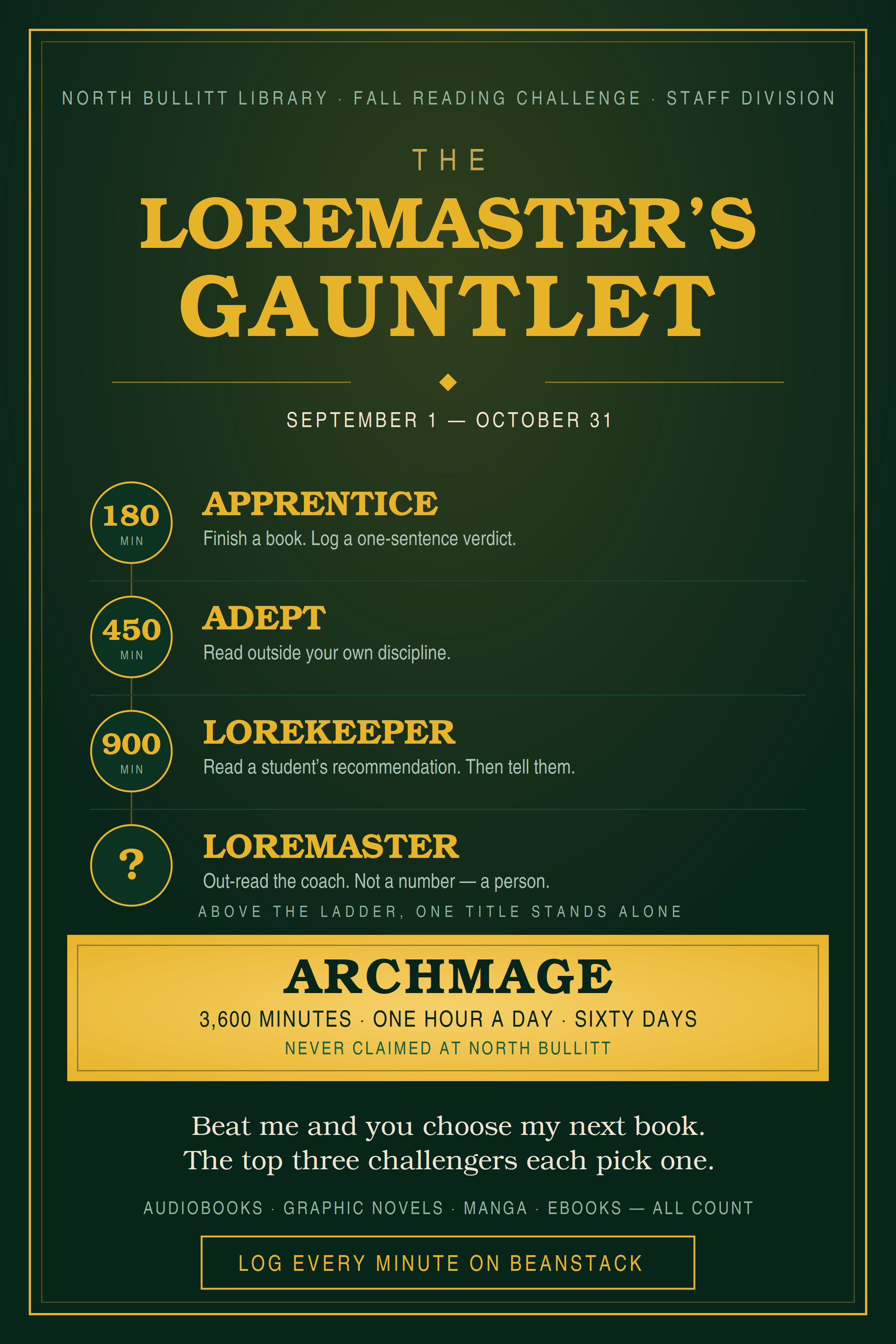
My plan is to (finally) read the four published volumes of Robert Caro’s Years of Lyndon Johnson. According to HowLongToRead.com, that’s about 61 hours of reading, all told. Those books have been sitting on my shelf for a few years now; it's time to brush them off and read them. Expect thoughts on each as I progress.
Along the way, I started re-reading The Gunslinger and finished up a few more essays from Montaigne (which is a great way to read his work, just one at a time).
A couple of upcoming book releases are on my radar. The first book born of the brilliant horror podcast The Magnus Archives, From the Library of Jurgen Leitner, releases just in time for Halloween. And Robert Greene returns to publishing new work with The Law of the Sublime, releasing in November.
That’s it for now, gang. I have longer, more detailed thoughts coming on how instructional coaching is really about systems brokering and why the “hero” teacher is a myth because the collective builds what the individual cannot.
MP