

“Ultimately, teachers must accept that they no longer need to be a fountain of knowledge and that their energy is better spent as an architect of learning experiences, a coach providing real-time support and feedback, and an analyzer of data to shape individual learning paths.” (Catlin R. Tucker, Power Up Blended Learning)
Sometime near the end of one school year in the pre-pandemic “God, everything was so much easier” days of education, I gave my 7th-grade math classes a “real world” task to finish out the school year.
Let’s acknowledge the elephant in the room - once those end-of-year tests are live and after they’ve wrapped, there’s not a lot of actual learning that takes place, mostly because the kids believe they’re done and they just need to ride out the last few days. Yet, teachers (me included) want to save the real-world stuff for the end of the year so it doesn’t get in the way of the important learning: prepping for the tests. I’ll come back to this later.
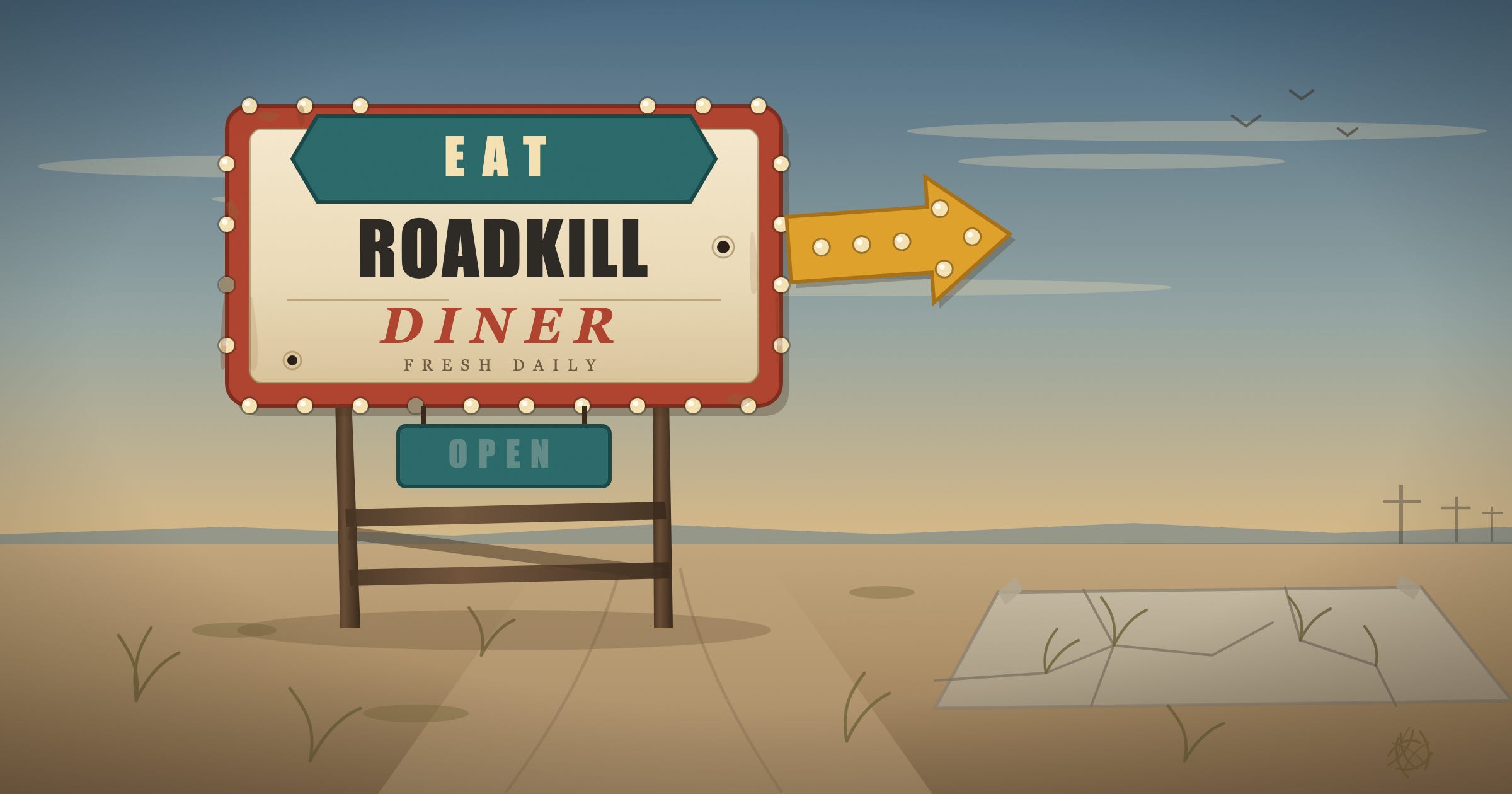
I found a 7th-grade math lesson online that was fun, gave the kids some actual work to do, and had a heck of a hook. The task? They were going to “save” a failing diner by building a new menu for them, using recipes made from roadkill.
Mike, will you share the lesson with us?
*NO. Mostly because I don’t have it anymore, but it was also fairly terrible. Sorry. Work with Claude for a few minutes, and I’m sure you’ll have a better version.*
It’s as gross as you imagine. Also, there are several states that do allow you to collect roadkill for your own use. Log that tidbit back in the nooks and crannies of your mind for future reference, right behind the glass that says “Break in case of apocalypse”.
To be fair, the lesson did fit the requirement of being something positioned in the real world, albeit just barely and in the broadest terms. It wasn’t great, but we did have fun. I added a few requirements to flesh out the project; students had to build the budget in Google Sheets, they had some research requirements, they used Canva to design a new menu, etc. At the end of the day, it was really nothing more than a fancier tri-fold board presentation.
No one grabbed hold of the project and took it more seriously than the surface-level engagement; no one prepared a presentation for an actual business (we ended up not having time to present at all), and no one remembers it for anything more than what it was: a silly activity to wrap up the year.
Fast forward a few years. I’d moved out of the classroom and taken a position as the Digital Learning Coach for my district. That change happened right before the COVID-19 pandemic struck in March 2020 (I was actually at a training conference in Salt Lake City four weeks before we shut down public schools on March 13, 2020. Yikes.)
After surviving the pandemic years, I started a year-long teacher training cohort: the Future Shift Fellowship. This was my attempt to work with a small group of teachers to begin a shift to more authentic learning experiences.
We weren’t winging it, either. The whole year ran on something called the 4 Shifts Protocol, out of Scott McLeod and Julie Graber’s Harnessing Technology for Deeper Learning. It isn’t a program or a curriculum or a binder. It’s a set of questions you ask about a lesson you already teach. Hold onto that, because one of those questions turns out to be the entire point of this essay, and I didn’t understand it for a long time after I started using it.
Overall, it was a smashing success, but two experiences stand out for me, both from 3rd-grade teachers.
The first teacher took an existing reading/writing unit that had students writing about famous inventions. They could pick the invention, but the original task only had them write a couple of paragraphs. Remember: 3rd grade.
The teacher made a small change in the task. She gave students three options for the task (another student agency opportunity): Student groups could choose to write a newspaper article about the invention, create a website about the invention, or do a “breaking news” video.

Every. Single. Group. All of them chose the news video.
The teacher told me that, for the first time, students were asking if they could do some work on this assignment at home. They wrote more and planned more than anything they did the entire school year (Her words, not mine).
They had full control over the video and how they presented themselves, how they recorded the video, how they edited the video, everything. Most used Canva video templates - they have several newscast templates perfect for this task - and wrote their own scripts. Some students didn’t really dress up or have much scenery, but there was that one pair of young ladies...
These girls. They stole their setup from watching “Good Morning America” or the “Today Show” - they came in nice clothes, hair fixed, and, the pièce de résistance... they brought their own coffee cups to sit on the desk in front of them.
The videos were fantastic, the kids learned so much, and, maybe most importantly, the teacher said she’d do it again. As a matter of fact, her class started a podcast to chronicle their year together very soon after this.
The other 3rd-grade teacher took a different path. She had a unit on economics and decided to have students create a “market day” - they could work together to create a business. They had to market the business, come up with a name, graphics, products... starting from the ground up.
All this may sound pretty familiar and unoriginal, until you learn one more thing: the teacher brought in someone from the local city government to talk to the students about what it took to start a business and about business licensing.
As part of that talk, the students prepared their own applications for their business licenses. However unofficial these licenses were, they went through the same process any other business would. And, they received their license before the market day. During market day, while everyone was walking through the stands in the halls, hanging behind each one, stamped with an official stamp and everything, were their business licenses.

These aren’t perfect examples. We certainly didn’t talk about how to assess the work, nor did we do a deep dive into standards alignment. The whole point of this exercise was to make the learning more authentic - to get it outside the realm of the school walls.
Now, let’s say these teachers had their projects going on at the same time I had mine. You might think that mine, because it was with older students, using more tools, and perhaps providing more evidence for their work, would be the task seen as more authentic.
But... they had business licenses and coffee cups.
Here’s the part that took me years to work out, and I’d like to save you the years.
I wasn’t looking at the task; I was looking at the facade in front of the task.
My project looked like the real world. It had a business in it. It had a budget, and budgets are serious. It had research, a designed menu, and a hook you could tell at a dinner party. If you had walked past my classroom with a clipboard, you’d have written down “real-world application” and moved on down the hall feeling good about seventh grade.
But look at where all of it came from. I invented the diner. I invented the diner’s problem. I decided the diner was failing, I decided roadkill was the answer, and I was the only human being on this earth who ever laid eyes on what those kids came up with. The whole thing started in my head and ended in my gradebook. Nothing about it ever touched anything outside the walls of that building.
That’s a closed loop. And a closed loop can be as realistic as you like — that’s the trap. Realism is cheap. A school can manufacture a perfectly plausible scenario all day long without ever picking up the phone. My diner was more plausible than a bunch of eight-year-olds selling friendship bracelets in a hallway. My scenario would hold up better in a business class. The difference wasn’t plausibility.
The difference was that one of those hallways had city hall in it.

So here’s the ladder I wish somebody had drawn for me back then:
Does the work look like what real people do?
Does it use the tools real people use?
Does anybody outside the room ever see it?
And does it go anywhere?
Four rungs. I made it to about two and a half, put a bow on it, and called it authentic learning. Most of us do. I’ve seen a hundred projects since then that stop right where mine did, and they’re all built by people who care.
And now the part I’d rather not write.
Of those four shifts I was supposedly making — deeper thinking, authentic work, student agency, technology — the one I actually made was the technology one. Google Sheets. Canva. A research requirement. I moved that project further on the technology dimension than on the other three put together.
Which figures, doesn’t it. Technology is the only one of the four you can buy. It’s the only one with a vendor and an invoice and a rep who’ll bring donuts. It’s the only one that shows up in a photograph. You cannot take a picture of a kid exercising judgment, but you can absolutely take a picture of a kid with a Chromebook, and I promise you that picture is in somebody’s board presentation this month.
I actually wrote this down myself, three years ago, in the first newsletter I ever sent:
“The last question to ask when shifting to deeper learning is ‘what technology should we use?’ That’s the least important question.”
I meant it. I still mean it. I had also, a few years before writing it, built an entire unit where the technology was the only thing I upgraded.
There’s a story I used in that same newsletter, and it fits my diner a lot better than it fit the thing I originally aimed it at.
Malcom McLean owned a trucking company and had driven a truck himself, and he was sick to death of sitting in traffic on the coastal highways. So on the 26th of April, 1956, he sailed a converted tanker called the Ideal X out of Newark with fifty-eight boxes on it. That’s the whole idea. Put the freight in a box instead of hauling the entire truck. He wasn’t trying to reorder global trade or hand the next century to Asia’s ports. He just didn’t want to sit in traffic anymore.
Now here’s the part I keep coming back to. The professionals thought this was a dumb idea, and they had good reasons.
Experienced stevedores could pack a ship’s hold beautifully — every good in its own optimal packaging, every gap filled, nothing wasted. Why would you take that and swap in a bunch of identical rigid boxes that fit worse? Why fit square boxes into a round-bottomed hull? Half your customers don’t ship exactly one box worth of anything, so now you’ve got containers going out half empty, or packed with three customers’ orders that have to be untangled at every single port. And once the box goes off on a truck, somebody’s got to chase it down and bring it back. McLean himself lost hundreds of them.
He wasn’t the only one who tried it, either. Plenty of others put containers on ships around the same time and quit. Not because they were dinosaurs — but because they lost money on it.
Sönke Ahrens tells this story, and his read on why the others failed is the sentence that got me. They tried to fit the container into the way they already worked. They kept their infrastructure, kept their routines, and bolted the new thing onto the old system. They were standing on the dock looking at crates and asking why they should pack everything a second time.
What McLean understood was that the ship owner’s point of view isn’t the one that matters. What matters is the purpose of the whole trade — getting the goods from the person who made them to the place they’re actually going. And the box only paid off once every piece of the chain got rebuilt around that: the packing, the ships, the cranes, the harbors, all of it.
Well.
That was Google Sheets and me. I stood on my dock (The diner project) and asked how to fit the new tool into the unit I already had. I never once asked where the work was going, or who was on the other end of it, because as far as I was concerned there wasn’t another end. I was the destination.
So ends the story of the diner. New tools, unchanged confines.
Now let me go back to that protocol, because the answer was sitting in it the whole time and I walked past it for years.
The 4 Shifts Protocol has four sections, and the first thing worth noticing is that authentic work is one section, separated from student agency. McLeod and Graber didn’t fold those together, and I think most of us in this business do fold them together, constantly. We say “authentic” when we mean “the kids got to choose,” and we say “student-centered” when we mean “it looked like a job.”
Keep them apart for a second, and you can see all four corners of the room. A task can hand students every decision and never once leave the building. A task can make real contact with the world while the teacher decides absolutely everything. Neither one is the whole thing. My diner was low on both, dressed up as high on one.
Then there’s the section on authentic work, and this is where I got humbled by a piece of paper I’d been handing out.
The section opens with a question I would have passed: is student work authentic and reflective of that done by experts outside of school? Sure. Restaurants have menus and budgets. Check.
But further down, under a question about whether students are creating real products for real audiences, there’s a sub-question. It’s indented. It only exists if you answered yes to the one above it. Here it is:
“Does student work make a contribution to an audience beyond the classroom walls to the outside world?”
That’s the only question in the whole protocol you have to earn the right to ask. Every other item, you can just walk up and answer. That one is conditional. You don’t get to it unless the work already has a real audience — and if it doesn’t, the question isn’t even on the table for you.
I never earned the right to ask it. Not once in that unit. And I’d been carrying the protocol around in a folder.
The third-grade teacher earned it with a phone call. That’s the whole trick. She didn’t design a better simulation, she didn’t find a slicker template, she didn’t buy anything. She called somebody downtown and asked if they’d come talk to eight-year-olds about business licenses. That’s the difference between my project and hers, and it cost her one phone call and a little nerve.
The researchers back this up, though I want to be careful about how hard I lean.
Koh and colleagues lay out four principles for authentic assessment: the task represents complex work in the field, students can see the criteria, students judge and revise their own work, and students present and defend it to real audiences. Read that list twice and notice what I noticed — only the first one is about looking real. Three of the four are about what students get to do and who they answer to. (Fair warning on this one: it comes from instructors studying their own course, so treat it as a good lens rather than proof of anything.)
And Stenalt and Lassesen went looking for student agency across twenty-nine studies and kept finding something else wearing its clothes — students energetically committed to plans somebody else had already made. Institutions, it turns out, are very good at growing the exact kind of “agency” that serves the institution. Their work is mostly college students and mostly surveys, so salt to taste. But the warning travels just fine.
Willing compliance is still compliance. My kids were compliant and cheerful and busy. So was I.
Now, I can hear the front row of the virtual audience the following question:
So I should burn my rubrics, turn ‘em loose, and call the mayor?
No. Lord, no. And I want to be careful here, because the version of this argument that gets people hurt is the version where structure is the villain.
Structure was never the enemy. Deciding everything in advance is the enemy. Those are different things, and the difference is worth a paragraph.
There’s a classroom in the research I keep coming back to — Robertson and her colleagues wrote it up. The teacher picked the science content. She modeled the strategies. She held the line on what students were accountable for. And inside all that structure, the students chose which words in the text were worth their attention, and then had to defend the choice. Destination fixed. Path open. It’s one classroom and one vignette, so don’t build a district initiative on it — but it demonstrates the thing teachers doubt most, which is that clarity and agency can sit in the same room without one strangling the other.
The 4 Shifts protocol says the same thing about itself, and this is the part I skipped for two years because I was reading it as a checklist.
Right at the top, before any of the questions: pick only a few. Target them. Build on small wins. Their words, not mine — “The goal is NOT to hit every aspect of the protocol every time.” And then, a few lines later, a warning I wish every district would tattoo on something: it is not an evaluation tool, and it “should not be used as a ‘gotcha’ mechanism by administrators or peer reviewers.”
So nobody has to take a third-grade class to city hall next Tuesday. Nobody has to redesign a unit from scratch this weekend. One rung is a year’s work. The teacher who did market day changed one thing about a unit she already taught. She made a phone call.
That’s the whole ask. Pick one lesson you already have. Move it one rung.
There’s a mirror-image sin here, and I’ve committed that one too.
It’s the teacher — usually a good one, usually on a Monday — who stands up and says this quarter, y’all are going to take ownership of your learning, to a room where some kids showed up already owning things and some kids didn’t.
Brod has a list of what a student actually needs before open-ended work pays off: some belief that their own actions matter, enough knowledge to have something to think with, the thinking tools themselves, and the ability to notice when they’re lost. Hand the keys to a kid who has all four and watch him drive. Hand them to a kid who has two, and you haven’t given him freedom; you’ve given him a longer way to fail in front of his friends. (Brod is writing commentary rather than running a trial, so take the list as a good argument. Honestly, the evidence I trust most here is my own eyes and yours. You’ve watched this happen. You know exactly which kid I mean.)
So the question I ask now about any scaffold: does it transfer judgment, or does it just make dependence run smoother? Those look identical on a lesson plan. They are not remotely the same thing in June.
And while I’m poking at things, let me poke at the protocol, because I use it and I’d rather be honest about it than sell it.
One of the agency items asks whether students get to take initiative — whether they can be entrepreneurial, self-directed, go beyond the given parameters. Scored as a positive. And it is a positive.
But it never asks which students have historically been rewarded for going beyond the given parameters, and which ones got written up for it. Same behavior, same room, two different files in the office. If you’ve been in schools any length of time, you know that going off-script reads as leadership in some kids and defiance in others, and you know how that sorting tends to break. A good instrument still has blind spots. That’s one, and I’d rather name it than pretend the tool is finished.
One more question from that protocol, and this one you can run tomorrow, in a hallway, for free. It asks whether students can identify what they’re learning — not just what they’re doing.
Walk into my classroom in May of that year and ask a kid what he’s learning.
We’re making a menu.
Walk into that hallway on market day and ask.
How a business gets permission to exist.
Same question. Two different answers, and only one of them is going to be in that kid’s head in ten years.
Which brings me to feedback, and to the thing about my diner project that still bothers me most.
There’s a big meta-analysis on feedback — Wisniewski, Zierer, and Hattie, something like 435 studies — and the useful finding isn’t the headline number. It’s the split. Feedback that carries actual information does a great deal. Feedback that just renders a verdict does close to nothing. (The studies underneath it are old, median vintage somewhere in the mid-eighties, and the numbers wobble. Don’t quote me a decimal. The principle holds.)
Fine. Everybody says give better feedback. Here’s the part nobody told me.
Information has to have somewhere to go. Feedback informs a decision. If every decision in the task was already made — by me, in July, on a lesson plan I found on the internet — then the finest, most specific, most lovingly-crafted feedback in the world has no place to land. It can’t change anything. All it can do is tell the kid how well he obeyed.
And a closed loop makes it worse, because in a closed loop I’m the only judge there is. I invented the diner, so I’m the sole authority on whether the menu would have saved it. There’s no appeal. There’s no reality to check against. My opinion isn’t feedback at that point; it’s just an opinion.
Compare that to a hallway with actual customers in it.
Those kids got feedback all day long. Somebody walked past their stand and didn’t stop — that’s feedback. Somebody bought out their whole table in nine minutes — that’s feedback. Somebody asked a question they couldn’t answer — that’s the best feedback in the building, and it cost the school nothing, and no adult had to write a rubric to generate it.
That’s what contact buys you. Not just something for the kids to decide. Somebody besides me to answer to.
So let me put the pieces in order, because the order matters and it’s the only defense I’ve got.
Somewhere around 2017, I built a unit about roadkill and a failing diner, and I thought I was doing real-world learning, and I wasn’t. I was doing school with better graphics.
In January of 2023, I sat down and wrote — in public — that the last question you should ask about deeper learning is which technology to use, and that it’s the least important question there is. I meant every word. I had also personally proven it the hard way and hadn’t yet noticed.
And then I started a fellowship, and handed a group of teachers a protocol I only half understood, and got out of their way.
And a third-grade teacher made a phone call.
I want to be plain about this, because I think it’s the most useful thing in this whole piece: the correction worked better in her classroom than it ever worked in mine. She got to a rung I never reached, with eight-year-olds, with poster board, without a single spreadsheet. I brought the framework. She brought the nerve to use it on somebody outside the building.
That’s not a sad ending. That’s how this is supposed to go. You spend a career getting a little less wrong, and if you’re lucky some of it lands in a room you’re not standing in.

So here’s what I’ve got, and it’s two questions, not a rubric.
What are these kids learning here that works outside this building?
And who out there ever sees it?
If the honest answer to the second one is me, then it doesn’t matter how good the hook is, or how clean the slide deck is, or how many tools we bolted on.
You’ve built a diner.